Fact-Checked AI Content
Getting started with content review workflow for SaaS teams: A beginner guide for SaaS teams setting up a repeatable review process for AI-assisted content.
A practical content review workflow for SaaS teams: Assign review owners, verify facts, separate style checks, and publish AI-assisted content safely.
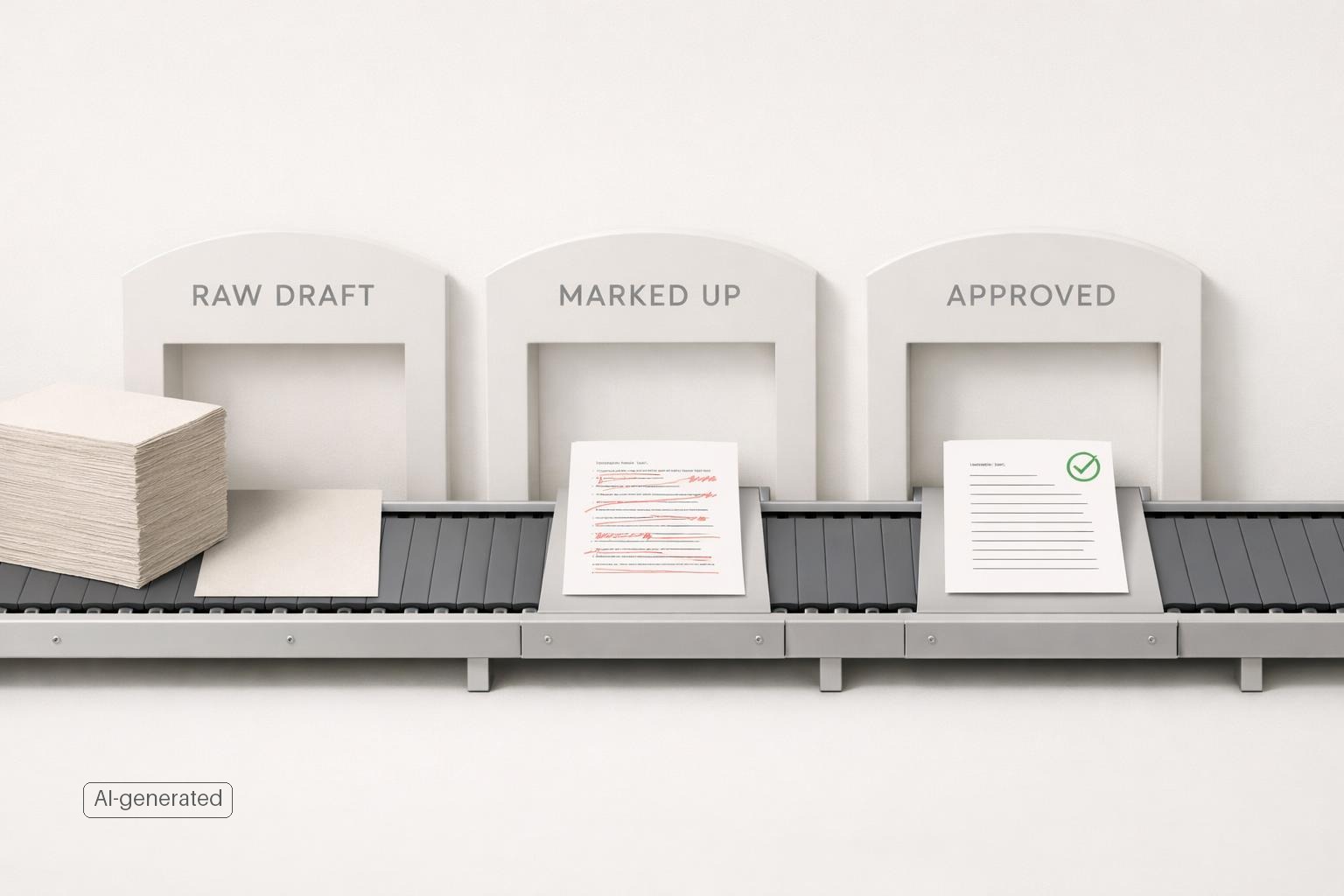
Quick answer: A workable content review workflow for SaaS teams is simple: define who owns each review step, decide what must be checked before anything goes live, separate factual review from style review, and use automation only to move drafts and approvals forward, not to replace judgment. That matters more with AI-assisted content because AI can speed up drafting and research, but it can also introduce factual errors, vague claims, and generic wording if nobody verifies the output. If you want a repeatable system, start with one content type, one approval path, and one checklist.
TL;DR
- Most SaaS teams do not need a complex editorial operation. They need a short, enforced workflow with clear owners, deadlines, and publish criteria.
- AI is useful for research, outlining, drafting, editing, and scaling output, but human review still matters for accuracy, originality, product truth, and brand fit.
- A good review workflow usually has five stages: brief, draft, factual review, editorial review, and final approval/publish.
- Use tools to route work and collect evidence, not just comments. The best workflow leaves an audit trail of what changed, why, and who approved it.
What should a SaaS content review workflow include?
At minimum, a SaaS content review workflow should answer four questions:
- What content are we producing?
- Who reviews it?
- What are they checking?
- What happens if the piece fails review?
That sounds basic, but many teams skip it. They let AI generate a draft, drop it into a doc, tag three people, and hope comments resolve themselves. The result is delay, duplicated feedback, and inconsistent quality.
A cleaner approach is to map review by content type. A product-led comparison page needs a different review path than a thought-leadership blog post or a help article. Smartsheet recommends starting by listing the content types you produce and then mapping review stages, roles, and deadlines for each. That is good advice because “review” is not one thing. For SaaS teams, it often includes:
- Strategic review: is this topic worth publishing?
- Factual review: are the claims, screenshots, product details, and examples correct?
- Editorial review: is the structure clear and on-brand?
- SEO and AEO review: does it answer the intent cleanly and support discoverability?
- Legal or compliance review, if needed
Zoho’s workflow summary is also useful here: after creation comes review, where the team checks for accuracy, tone, style, and errors. That gives you the core categories.
If you are just setting this up, do not build five branches and twelve statuses. Start with one workflow that covers 80% of your SaaS content, then add exceptions later.
Who should review AI-assisted content, and in what order?
The right order is usually: writer or operator self-check, subject matter expert review, editor review, then approver.
That sequence reduces expensive bottlenecks. If your head of product or founder is the first reviewer, they will end up fixing issues that should have been caught much earlier. Foleon’s guidance is sensible: clearly define roles such as content creator, primary reviewer, subject matter expert, editor, and approver.
For a beginner SaaS setup, these roles are enough:
1. Creator The person or system that produces the first draft. With AI-assisted content, this might be a marketer using prompts, a content lead working from a brief, or a workflow engine connected to your CMS.
2. Subject matter expert Usually someone from product, solutions, engineering, customer success, or sales. Their job is not to rewrite for style. Their job is to catch false claims, outdated workflows, misleading comparisons, and missing nuance. This is especially important for SaaS content because even small product inaccuracies can reduce trust and create support issues (Marketers Using AI Publish 42% More Content + New Research Report).
3. Editor The editor checks clarity, argument quality, structure, tone, and duplication. They also make sure the piece says something specific enough to earn attention. Semrush’s study found that purely AI-generated content appeared in the top spot far less often than human-written content, while also emphasizing that search rewards human originality rather than generic output (Does AI content rank well in search? Survey + Data study). Whether you agree with every detail of that study or not, the operational lesson is sound: editing for originality is not optional.
4. Final approver This person owns the publication decision. In a small SaaS team, that might be the head of marketing. In regulated categories, it may include legal or compliance.
A practical rule: each reviewer should have one lane. SMEs review truth. Editors review readability and fit. Approvers decide go/no-go. If everyone comments on everything, review time expands without improving quality.
What should your review checklist actually cover?
A checklist matters because AI failures are predictable. Search Engine Land’s QA guidance centers on checking accuracy, maintaining brand voice, and improving output quality (How to QA AI-generated content + free QA workflow checklist). Document360 makes the same point for technical documentation: if AI-generated material is published without human review, the risks include hallucinated endpoints, stale flags, and incorrect instructions (AI-Generated Documentation Review: The Complete QA Checklist).
For SaaS teams, the most useful checklist is short and enforceable. A reviewer should be able to complete it in a few minutes for a straightforward piece, and longer for complex product content.
Use something like this:
- Claim accuracy
- Are all product capabilities true right now?
- Are pricing, integrations, limits, and feature names current?
- Are any statistics, timelines, or “best” claims verified?
-
Does every external factual claim have a source?
-
Search and audience fit
- Does the piece answer the actual query early?
- Is the content aimed at one stage of buyer awareness?
- Does it include original detail, examples, or opinion instead of generic summary?
-
Does it cover likely follow-up questions?
-
Brand and editorial quality
- Is the tone consistent with your brand?
- Is the structure easy to scan?
- Are there unsupported claims, filler, or vague statements?
-
Does the intro promise the right thing?
-
Product truth and compliance
- Are screenshots current?
- Are competitor references fair and defensible?
-
Are regulated claims reviewed where necessary?
-
Publishing readiness
- Title, meta description, schema, internal links, CTA, and author details present if required
- URL slug, canonical logic, and CMS formatting checked
- Tracking and measurement ready
If you want one standard, make “publish-ready” mean more than “someone glanced at it.” It should mean evidence-backed, structurally complete, and approved by the right person.
How do you make the process repeatable without slowing the team down?
Repeatability comes from constraints, not complexity. The best beginner workflow is one that people will actually follow every week.
Start by reducing content variation. Pick one or two recurring formats first, such as: - Educational blog posts - Product-led comparison pages - Help-center articles
Then assign one standard service-level expectation for each stage. For example: creator self-check same day, SME review within two business days, editor review within one business day, approval within one business day. Without explicit deadlines, “in review” becomes permanent.
Quick answer: A simple starter workflow template for a small SaaS team
If you only have a marketer, one SME, and one approver, use this default SOP for AI-assisted blog posts and comparison pages. RACI: marketer = Responsible, SME = Consulted, head of marketing or founder = Accountable, CMS or ops support = Informed. Statuses: Briefed → Drafted → SME review → Editor review → Approved → Scheduled → Published → 30-day review. Deadlines: draft in 2 business days, SME in 2, editor in 1, approver in 1. If team capacity is tight, publish one strong piece every 2 weeks rather than forcing weekly volume.
Copyable checklist - Brief includes target query, audience, angle, CTA, and required proof points - AI draft completed and self-checked by creator - SME confirms product claims, examples, screenshots, and competitor references - Editor removes filler, rewrites vague claims, checks structure, links, metadata, and CTA - Approver decides publish / revise / reject - If reviewers disagree, the approver resolves tie-breaks using the brief and publish criteria, not personal preference - Post-publish owner checks indexing, traffic, conversions, and assisted leads after 30 days
For a small team, expect rough effort of about 2 to 4 hours for a simple blog post, 4 to 6 hours for a comparison page, and 1 to 2 hours for a short refresh. Track four workflow KPIs: average review cycle time, percent approved without major rewrite, publish on-time rate, and 30-day performance by piece.
Automation helps most with handoffs and tracking. NN/g notes that operations work often improves when repetitive tasks are automated and streamlined (Supercharge UX Research by Automating Workflows and Repetitive Tasks - NN/G). That applies directly to content review. You do not need AI deciding whether content is correct. You do want automation doing these jobs:
- Moving a draft from “ready for SME” to “ready for editor”
- Notifying the next reviewer
- Blocking publish until required approvals are complete
- Storing version history and approval notes
- Pushing approved content into your CMS
If you use a headless CMS, webhook-based automation is often the easiest path. CMS webhooks can subscribe to events such as content saves, workflow approvals, and publishes (autonomous SEO, AEO, and GEO content engine: SAGEOBOT is an autonomous SEO, AEO). In practice, that means you can trigger tasks when a draft changes status, route approved content to another system, or run pre-publish checks before release. For SaaS teams with custom stacks, this matters more than buying another editorial tool.
For topic selection and refresh workflows, pair the review process with performance data. Ahrefs recommends using Google Search Console to inspect page-level search performance during content audits. Semrush also notes that content gap analysis helps identify audience-relevant topics you have not covered or should improve. That is where a GSC-driven and gap-analysis loop becomes useful: not just reviewing content before publishing, but reviewing whether it deserved to exist in the first place.
Which tools are useful for content gaps, reviews, and CMS automation?
There is no single best stack for every SaaS team. The right setup depends on your publishing volume, CMS, and how much product review you need. But the tool categories are predictable.
For content gap analysis, the strongest options are usually your existing search data plus a competitive keyword tool. GSC is essential because it shows how your own pages are actually performing. For external gap discovery, tools from Semrush and Ahrefs are commonly used to find competitor topics and missed queries. If you are choosing one approach, start with your own data before chasing every competitor keyword.
For review management, many teams can start with what they already use: - Google Docs or Notion for drafting - ClickUp, Asana, Jira, or Trello for status tracking - Slack or email for notifications - A CMS workflow layer for approvals
For AI-specific QA, the tool is less important than the checklist and role clarity. A bad workflow in an expensive tool is still a bad workflow.
For CMS publishing and workflow automation, look for: - Status-based approvals - Role permissions - Webhook support - Version history - API access - Scheduled publishing
Webhook capability matters most when your content moves between systems. A headless CMS that emits events on saves, approvals, and publishes lets you connect editorial actions to downstream tasks. That can include posting approval requests, triggering screenshots, updating project boards, or publishing approved drafts on schedule.
This is where SAGEOBOT’s model is relevant in principle: the valuable part is not merely generating drafts, but continuously identifying worthwhile opportunities, preparing changes, routing them through human approval, executing supported updates, and measuring what happened next. A review workflow should support that same logic. Content is not “done” at publish. It should eventually be reviewed again based on search performance, AI-answer visibility, conversions, and freshness.
Bottom line
If your SaaS team is new to AI-assisted content, do not overengineer the review workflow. Define a small set of roles, create a short checklist, enforce one review order, and automate only the handoffs. That gets you most of the benefit quickly.
If you are publishing regularly, the next step is to connect review to measurement: use GSC-driven insights, content gap analysis, and post-publish audits to decide what to update next. A repeatable workflow is not just safer for AI content. It is what turns content production into an actual operating system instead of a pile of drafts.